

New Era Energy Partnership
Mar 17, 2026
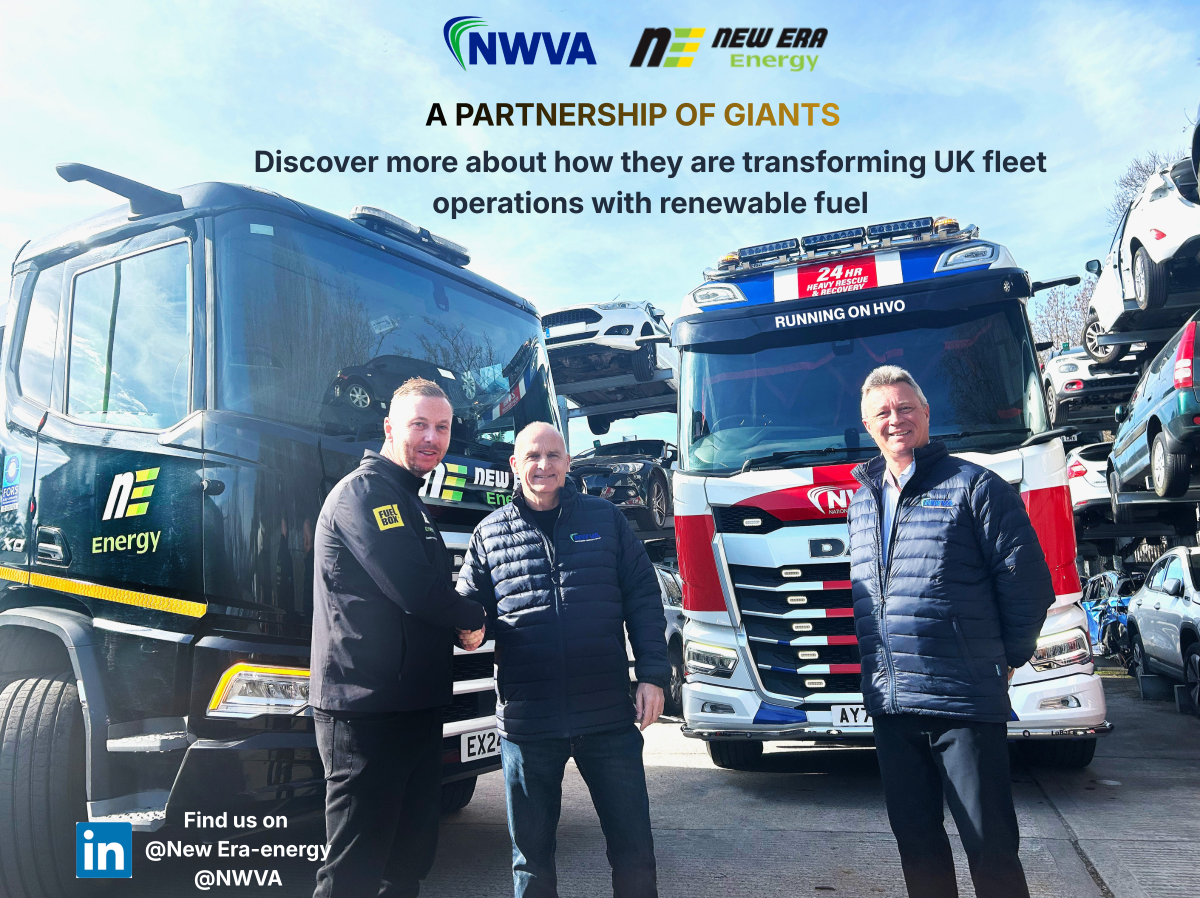
NWVA has announced a strategic partnership with New Era Energy, marking a major step forward in combining operational excellence with more sustainable fleet operations.
As one of the UK’s most established vehicle recovery and collision management operators, NWVA has built its reputation on speed, reliability and trust. As the transport sector faces increasing environmental and regulatory pressure, the business is now demonstrating that performance and decarbonisation can work hand in hand.
This new alliance with New Era Energy, one of the UK’s most accredited and fastest-growing fuel suppliers, is helping reshape how large, mission-critical fleets approach fuel supply, efficiency and emissions.
A partnership built on operational understanding
NWVA was founded by Mick Jennings and Lisa Jennings with a clear vision: to build a recovery business that puts reliability, people and accountability first. Today, the company coordinates more than 25,000 recovery specialists, incident managers and first responders, operating 24/7 from two UK control centres and one European control centre, with a recovery network spanning 32 countries.
As the business has grown, so too has the need for a fuel solution that supports both operational demands and environmental goals. NWVA began searching for an alternative fuel supplier capable of reducing emissions without compromising uptime or performance.
“We spoke to a lot of fuel suppliers – including some very large ones. On paper, they ticked boxes. In practice, they couldn’t adapt to how we actually operate. Nationwide recovery is the heart of this business. If fuel supply isn’t flexible, responsive and dependable, everything falls apart.”
– Mick Jennings, Executive Chairman, NWVA
Supporting the switch to HVO
At the centre of the partnership is NWVA’s transition to HVO (Hydrotreated Vegetable Oil), a renewable diesel alternative capable of delivering immediate carbon reductions without requiring engine modifications.
Unlike traditional biodiesel blends, HVO is a drop-in fuel meeting the EN 15940 standard, meaning it can be used in modern diesel engines without changes, downtime or risk.
Operational benefits have been clear from the outset, including improved engine performance and reliability.
- High cetane rating for improved combustion
- Cleaner, quieter engine performance
- Excellent cold-weather capability (down to -32°C)
- Sulphur-free and cleaner emissions profile
- No diesel bug (FAME-free)
- Long shelf life of up to 10 years
For a recovery fleet operating 24/7, these benefits are critical to maintaining consistent service levels.
Sustainability without compromise
Beyond performance, HVO delivers up to 90% lifecycle CO₂ reduction, supporting NWVA’s ESG strategy and helping clients reduce Scope 1, 2 and 3 emissions.
“This isn’t about optics. It’s about future-proofing the business. With New Era Energy, the adoption of HVO has been seamless – no disruption, no loss of performance. It strengthens our environmental position while reinforcing operational resilience.”
– Stephan Surmont, Group Managing Director, NWVA
Produced from waste-based feedstocks such as used cooking oil and tallow, HVO also supports the circular economy and is fully biodegradable, reducing environmental risk.
A scalable, customer-focused solution
New Era Energy’s service extends beyond fuel supply, including bulk delivery, lubricants, AdBlue, fuel cards, multi-site management and ESG advisory support — all tailored to real operational needs.
“We don’t believe in one-size-fits-all. Our role is to remove complexity for customers like NWVA, not add to it.”
– James Hunt, CEO, New Era Energy
Looking ahead
The partnership reflects a shared commitment to delivering sustainable, high-performance transport solutions without compromising reliability.
By combining nationwide recovery expertise with innovative fuel solutions, NWVA and New Era Energy are helping shape a more resilient, lower-carbon future for transport.